Wednesday, July 13, 2016

Asimina triloba: leaf problems

I've been away for about a week in Germany and this morning inspected developments on the fruit-bearing trees. I was surprised to find some of the newer leaves on the Wells were curling in a funny way and felt leathery in a way that pawpaw leaves don't usually feel. 


Looking at this picture, I'm noticing a lady bug at the top of one of the leaves, and I'm wondering if the lady bug is hanging out and eating whatever it is that's affecting the leaves.


Here's another shot with the lady bug more in focus.

Still the Wells cultivar. Strange because I don't remember seeing this in previous years.


Here you can see that they're not all curled


After looking at the Wells, I walked over to the Shenandoah and saw that the leaf curl was here too, though not such a bad case, apparently.

Another view of the Shenandoah

The KSU-Atwood didn't seem to have any leaf curl. But it did have a few leaves that looked like they had been eaten from.


So, not sure what'd going on with the leaves. Any ideas?


Update on 14 July 2016
On the curling leaves, I've emailed with Sheri Crabtree (Horticulture Research and Extension Associate at KSU) and she's suggested that the problem may be a calcium deficiency can cause curling and cupping like I'm seeing. She recommended a fertilizer with calcium nitrate or calcium sulfate, and cautioned against using too much lime on pawpaws because that can raise the pH in unhealthy ways. (She also said aphids or mites can cause similar damage but said it's likely not that, since in my email I told her I hadn't seen any insects; she commented that it doesn't look like overexposure to the sun, since the leaves would look brown/scorched and drop off the tree

She commented that the damage to the KSU-Atwood could be caused by a caterpillar and mentioned the zebra swallowtail, which the pawpaw is the exclusive plant host for. But that would be curious to have a zebra swallowtail caterpillar in Utah, where there are so few pawpaws. Interesting to think that another type of caterpillar in Utah may have deemed the pawpaw an acceptable host.


Thursday, June 30, 2016

Stragglers and Loungers

Yesterday I wanted to get some pictures of the seedlings with their numbers showing. So here they are. (It occurs to me that some aspects of this blog would be completely unnecessary to me, psychologically, if that bean I planted as a long-ago kindergarten activity would have just sprouted...)


Developments with the two seeds I got from the smallest pawpaw of September 2015: A1 sprouted and A2 can't be roused from its torpor, yet.
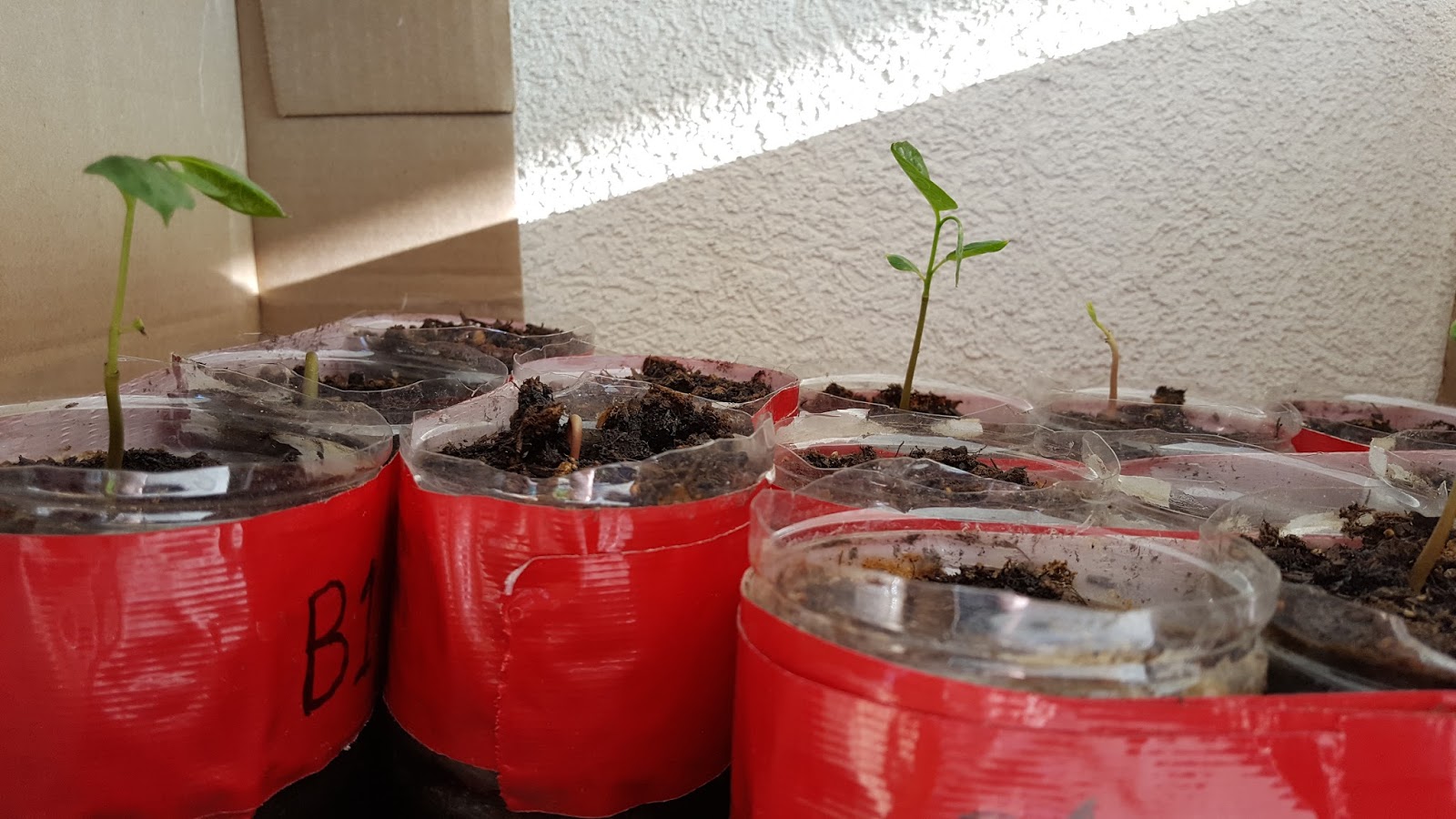


Developments with the three seeds I got from the second smallest pawpaw of September 2015: They've each sprouted. Interestingly, B2 was one of the very first to show its stalk among all of the seeds, but it still can't get its leaves out of the ground. B1's stalk showed up later than B2's, but it quickly passed B2. And B3--it didn't hear spring fire its gun so it lingered behind the starting line long after the race started, but just this week it proved itself a phenomenal sprinter: in the evening there was no sign of the stalk, the next morning the stalk was showing, and by the time I got home from work its small leaves were showing.


Developments with the five seeds I got from the third smallest (second biggest) pawpaw of September 2015: Every seed has germinated, but C2 and C3 have been very slow to get their leaves out of the ground. They were two of the first to germinate, but they've been stuck for weeks with their heads in the ground, with C1, C3, and C4 passing them up. You can see that C2 is showing some leaf that's still underground.

Developments with the ten seeds I got from the fourth smallest (the biggest) pawpaw of September 2015: For D1 to D5, three out of five have germinated. 

Developments with the ten seeds I got from the fourth smallest (the biggest) pawpaw of September 2015, continued: For D6 to D10, only one seed has germinated. (If you're paying more attention to these pictures than is reasonable, you'll see I've stuffed a couple dryer sheets in among the seedlings. I've noticed that a lot of small gnats are hanging around, and I wanted to see if dryer sheets would drive them away. But it doesn't work.)  


Looking at the trees, NJ pointed out some water droplets on a cluster of pawpaws.


After we looked at the trees and NJ went inside, W came home and pointed out the two buck mule deer lounging in our next door neighbors' backyard. When they weren't lounging, they were eating the neighbors' green apricots. Glad they know to stay away from pawpaws.


This morning I stopped by and saw that C2 and C3 were starting to get their leafy heads out of the dirt.

C3 from another angle


C2 from some other angles


Monday, June 27, 2016

Pawpaw Seedlings and a Parasitic Twin

On Saturday evening, we got back from Oregon and found that most of the pawpaw fruits are growing large, and in good clusters. This is the KSU-Atwood, but the Shenandoah and the Wells are also sporting some good pawpaw clusters.

Look behind this big cluster to the one in the background. 

It's a smaller cluster with what looks like the vegitative analog of a parasitic twin. You can see that earlier in the cluster's development, one of the pawpaws' stems broke and it wasn't connected to the branch anymore. But it held on, apparently conjoined to another pawpaw, whose stem is still in tact.


Probably anyone who has grown pawpaws for a year or two has seen this, but since this is the first time I've had the chance to watch them grow day by day, this development seems intriguing. I'm wondering if the parasitic twin will continue to get enough nourishment from its host pawpaw. 


Then on Sunday evening we went over to my parents house for dinner. They had done us the favor of taking care of the seeds/seedlings while we were gone.


I was glad to see that several had developed leaves, but I was surprised to see that there was only one additional seed that had germinated. A week ago there were 11 and now there are 12.


A Visit to One Green World

It so happens that last week we took a trip to Oregon, flying into Portland and then renting a car and heading down to the southern Oregon coast--North Bend, Bandon, etc. We didn't plan the trip to Oregon with One Green World in mind, but once we realized we would be spending a night in the same town (Portland) as the nursery that has supplied all our pawpaws, we decided we ought to stop by on Saturday morning (June 18). 

We drove over a covered bridge as we neared the nursery. I looked on wikipedia to see what the point of a covered bridge is, beyond the knee-jerk idea that a covered bridge is quaint and hence is good. Turns out the covering is supposed to preserve the wood of the bridge.  

We arrived! To what we regard as the center of all pawpawdom west of Kansas. Here's the home range as a reminder.

And they were open

One of the workers took us back and showed us the pawpaws, placed under some shade cloth, since they're sensitive to sun during their first year.

Here they are, as well as in the next few pictures.


After looking at the pawpaws, we looked around and NJ pointed out this flower

And the worker showed us a type of kiwi that they sell

And we looked at other plants along the way


Here some of us are, after the visit, out in the parking lot. One of our Portland friends wondered why we stopped if we weren't buying anything. We didn't use the word pilgrimage in our explanation.