![]() |
| So here we all are: swallows, saguaro, pawpaws, and humans, part of the rambunctious garden of the post-wild world. |
Friday, July 27, 2018
Who's the Interloper?
Tuesday, July 24, 2018
Lazarus Pawpaws
![]() |
| A "Lazarus species" is a species that has long been thought to be extinct, but then it turns out that someone discovers that the species still exists, still lives somewhere. So it has the appearance, though not the reality, of coming back from the dead like Lazarus from the Bible. The linocut print that I've made here, of a raven adding a fossilized trilobite to its trilobite collection, is something I imagine taking place in Millard County, Utah. That's my wildest dream--a raven exhibiting culture by treating fossilized trilobites (animals that dominated the world during the Cambrian era some half a billion years ago) as if they were tokens or trinkets to be collected and even exchanged with other ravens. My wild dream beyond this wildest dream: that the trilobite were to achieve status as a "Lazarus species" by being discovered, alive, scuttling around in some hot spring down in Millard County. (Why Millard County? Because that county is home to the famous fossil trilobite beds of Antelope Springs.) |
![]() |
| But this blog post is titled "Lazarus Pawpaws" rather than "Lazarus Species." That's because of what's happened recently with the batch of twenty-four pawpaw seeds I planted on 29 March 2018. As you'll recall from that blog post, I tried scraping the seed coasts against the pavement before planting them, with the aim of helping the little plants come out of their shells (something they had a problem doing when I planted seeds in 2017). But by the beginning of July, scraping the seed coats had seemed to be a phenomenal, colossal failure, since none of them had germinated. I removed the seedlings from the sun and placed them under the carport and stopped watering them. That was that, I thought--they were extinct. |
The Fallen
![]() |
| The other day we were out by the pawpaw trees and NJ pointed out a few pawpaws that had fallen prematurely. |
![]() |
| I picked them up and carried them over... |
![]() |
| ...to the other pawpaws that have fallen early during this summer. |
![]() |
| Here they all are, next to the seedlings I planted in 2017. |
It's nine pawpaws fallen so far this year, but we've got dozens more on the trees, so we're okay.
Sunday, July 8, 2018
Pawpaws at the National Museum of the American Indian
In late April we left Utah for about a week and went to Washington DC for a conference. During the trip, we went to the National Museum of the American Indian, one of the Smithsonians.
It's a great museum, dedicated to history and Indigenous Americans' hundreds of living cultures. A few of the things we saw during our too-brief visit:
![]() |
| A narrative of how Raven stole the sun. |
![]() |
| Raven's beak with the sun in its mouth. |
![]() |
| A cosmology. |
![]() |
| A nice painting of some pueblos in the US Southwest, where we grow our expatriate pawpaws. |
![]() |
| And then as we left we did a double take--pawpaw trees hanging over the sidewalk on the museum grounds! |
![]() |
| Another pic of the fruit. |
Were these trees here just randomly because this was their home range? It turned out they weren't just random but were planted "to honor the natural landscape that existed prior to European contact." Indeed, according the museum's website: "At the museum's entrance, a spectacular wetland is home to fruit-bearing paw-paw trees, lush aquatic plants and native birds, reptiles and amphibians--a serene setting that muffles the sound of the cars and trucks traveling along nearby Independence Avenue."
Here's another relevant URL, with a blog post done in Nov 2014 by, by an intern for the Archives of American Gardens. It turns out the Smithsonian Tree Collection has seventeen pawpaw trees, including these at the Museum of the American Indian.
Sunday, June 3, 2018
Black-chinned Hummingbird in a Pawpaw Tree
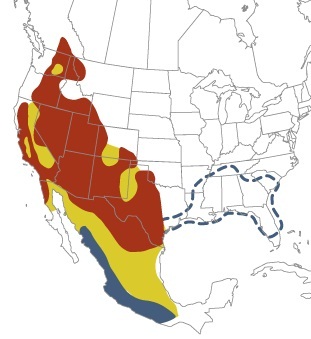
| The pawpaw naturally grows in the eastern United States |
![]() |
| Meanwhile, the black-chinned hummingbird lives in the western United States, though it passes through the US south for migration purposes (dotted lines). |
So these two species don't meet all that often. But the other day in the yard, NJ and I saw a black-chinned hummingbird doing a horizontal figure-8 flight pattern while facing the KSU-Atwood (we've also seen this happen in front of our raspberries recently).
![]() |
| Then the hummingbird landed. |
![]() |
| Here's a pic of the hummingbird looking at me as I walked closer to it. |
![]() |
| Here's the pic I got right before it flew away. |
Sunday, May 20, 2018
What a Morning! Pawpaw Blossoms
At the end of April, I walked into the yard one morning and the sun was hitting the pawpaw blossoms just right. What does it mean for the sun to hit pawpaw blossoms just right? It means that the sun hits them in a way that showcased the fact that they're purple and turns their often drab purple into a brilliant purple. See below.
Pollinating Pawpaws, and and the First Pawpaw of 2018
For fairly extensive discussion of pollinating pawpaws, see this blog post from a few years ago. For a few pics from this year's work in pollinating the pawpaws, see below. (I took these pics at the end of April, so I'm doing some catch up.)
Subscribe to:
Posts (Atom)