Friday, May 19, 2017

Pawpaw Seedlings and Sun Damage

Like I say, we got back from Spain a week ago today. While we were in Spain, my dad took care of the pawpaw seedlings (which first sprouted on 7 June 2016). He also took care of this year's batch of planted pawpaw seeds (which I hope will sprout sometime next month).

When I took the seeds and seedlings over to my parents' house, I set them out on their back patio, which is covered. I set them at the edge of the patio, so that they could get some shade but also get more sun than they had been getting. 

When I got back from Spain, I found that this year's batch of planted seeds have remained inert, although as you see below they attracted a large flying insect.


After I took a pic of the flying insect, I looked around for the seedlings and found them moved from where I had placed them. They were moved far from the edge of the patio, pushed up against the house, far into the shade. They had developed more and bigger leaves but something was wrong...


The leaves on each seedling were curled and almost shriveled.
See: 


When Dan Carpenter came over and took a couple of the seedlings back in March, he asked if they could be out in full sun. Like me, he had heard that pawpaw seedlings need shade. I told him that I had read that they need shade for the first year but after that they should be okay for full sun. But, also told him, I didn't know if "first year" referred to the year they sprouted or the year after they sprouted. Too bad these 2016 pawpaw seedlings got sun damage, but I'm glad to have found out that "after the first year" means keep your pawpaw seedlings in the shade during the year they sprout and also the year after they sprout. I'm hoping these ones can recover from having their first few leaves burned and can still grow up to be good strong pawpaws.

FYI--Here's what KSU has to say about shade and sunlight for pawpaw seedlings:

Site, soils, and habitat
Although the pawpaw is capable of fruiting in the shade, optimum yields are obtained in open exposure, with some protection from wind (on account of the large leaves). Germinating seedlings, however, will not survive under those conditions because they are extremely sensitive to full sunlight, which can kill them. (Containerized seedlings may be grown without shade in a greenhouse.) Shading for the first year, and sometimes the second, is normally required outside, and it is for this reason that pawpaws are almost always found in nature as an understory tree. The soil should be slightly acid (pH 5.5-7), deep, fertile, and well-drained. Good drainage is essential to success. Pawpaws will not thrive in heavy soil or waterlogged soil. In habit it is a small tree, seldom taller than 25 feet. Grown in full sun, the pawpaw tree develops a narrowly pyramidal shape with dense, drooping foliage down to the ground level. In the shade it has a more open branching habit with few lower limbs and horizontally held leaves. 

KSU info available here.

Saturday, May 13, 2017

Spain, New Pawpaws, Scale Insects

We just got back from a two week trip to Spain. NJ was traveling there for work and I tagged along. Her conference was in Madrid, and we also went to Granada where we saw the Alhambra, to Malaga where we swam in the Mediterranean, and to Toledo where we enjoyed the most picturesque streets and buildings while feeling some degree of desperation regarding the general lack of restrooms available to visitors to the town.

Here are a couple of fruit-oriented pictures from Spain and a few pictures of the pawpaws now that we've made it back and can see how they've been developing this year.

Especially in Granada we saw a lot of orange trees, which we learned the Arabs brought to Spain centuries ago because of the smell of the blossoms. They do have great smelling blossoms. We were disappointed that all of the oranges, which looked ripe, were out of our reach. But after church on Sunday we were walking away from the chapel and found some trees outside of the tourist section. These trees had oranges we could reach. This was great, since I had told NJ that my fondest desire while in the town where the Alhambra is located, would be to eat a true Spanish orange. We split one, and tasted the vast difference between an improved culinary orange and an orange that is planted just for the smell of its flowers. The orange tasted like a bitter grapefruit (not a standard grocery store grapefruit but a bitter grapefruit). As I said to NJ after we achieved my fondest desire by eating the orange: the unimproved pawpaw is in very little need of improvement compared to the unimproved orange!

In Malaga we went to a fish and fruit market, and although we like both fish and fruit, we gravitated to the fruit. We saw dragon fruit and mangosteens and big grapes and peaches and a kind of fruit that was locally in season called the niparo (later we learned the common name in English is the loquat--but not that common, since we hadn't heard the name before, nor had we seen the fruit). While cruising around the market, we stopped at one stall and I touched a peach to see how ripe it was (it wasn't). And then I picked up the peach, and soon the proprietor of the stall was yelling, saying, "Oiga. Oiga! Oiga!! OIGA!!!" Finally on the last loud  "OIGA!!! (LISTEN!!!)," I realized he was yelling at me. And I remembered something that a friend had warned me about a couple months earlier: when in Spain, you can't go around just touching the fruit that's on sale because people get mad. I found this to be true, and I said, "Lo siento" and put the peach down. It's kind of ironic to say "Lo siento" when you're being yelled at for feeling fruit, since "lo siento" means "sorry," but literally it means "I feel it," which is exactly what the good man was yelling at me not to do.

After I was yelled at, we moved on to another stall and bought some niparos, since we wanted to try them. They were 1.50 euros/kilo. And we didn't know if one kilo would be enough (we're such optimists--we might have worried, instead, that one kilo would be too much). So we bought two. And as the man filled a heaping bag, I was reminded that a kilo is quite a big larger than a pound. So we found a bench and sat down and ate probably a kilo of niparos, which reminded me of kiwis, before leaving the remaining kilo of niparos on the bench in the hopes that someone else would find them and enjoy them.

While we were in Spain, we heard from my parents that the talavera plate we had bought in Puebla, Mexico, had fallen (spontaneously!) from the wall and broken on our tile floor. Oh how sad we felt! But they saved the pieces and, if the plate had to die, we're glad it's now reincarnated as a set of potsherds adorning NJ's mother's day present.

Okay, so I know several of you have been looking forward to seeing whether the fruit has set on the pawpaw trees this year. It has! It's fun to check the trees day by day (as I do when I'm here), but it's also fun to be away and see the development that takes place over the course of two weeks. And so, without further adieu (I'm just kidding--I know it's ado), I present to you some exquisite pawpaw pictures:

Click on them and they look even more exquisite.


So fun for me to see so many pawpaws growing on the trees!

But the fly in the ointment was that I found some scale insects in the pawpaw orchard. Not many--maybe five on the Shenandoah, three on the KSU-Atwood, and none on the Wells (though I admit I was tired of looking by then, and the low numbers hardly made it feel like an infestation).


I'm rethinking this sentence, which I used just a few lines above: "But the fly in the ointment was that I found some scale insects in the pawpaw orchard." My goals in life aren't exceptionally lofty--my fondest desire in Granada, after all, was to eat a true Spanish orange. But here's one of my loftiest goals, and if it's achieved at some point, the purposes of this blog will largely be accomplished: for the phrase "scale insects in the pawpaw orchard" to replace or at least compete with the phrase "fly in the ointment" as a metaphor for an otherwise good situation that is spoiled by some minor problem. For instance, I would like to be widely understood if I were to say something like this: "When it came to that wonderful fruit market in Malaga, the true scale insect in the pawpaw orchard was when the proprietor yelled at me for touching the peach."

Friday, April 21, 2017

Utah Pawpaw Growers: Part 2

I know that those of you who have read my 23 October 2016 blog post, titled "Utah Pawpaw Growers: Part 1," have been anxiously awaiting a follow-up, reasoning that if there is a Part 1, there ought to be a Part 2. And here it is.

On Wednesday this week Greg and Lora and their daughter came over to collect some pawpaw pollen, as I mentioned earlier.

I sent them off with some pawpaw pollen

And I sent them off with some stratified pawpaw seeds
And I asked if they would be up for being the second in the "Utah Pawpaw Growers" blog post series. They thought that sounded okay. So here's my subsequent email Q&A with Greg.

BR: How did you first hear of pawpaws? Is there a story? 

GO: I don't really know. I remember reading about them in a Gurney's magazine and I was always curious abut them. I imagined that they tasted like a bland mushy banana from their descriptions, but maybe worth a try.

BR: Why pawpaws and not peaches?

GO: Actually I grow and love both, it is hard to beat either one of them when they are dead ripe. I do like the fact that you don't need to spray pawpaws.

BR: Which pawpaw cultivars did you choose and why?

GO: I have tried growing Wabash, NC-1 and Patomac as well as several seedlings. I did a lot of research on what ones taste better by looking at KSU's tasting reports and what people had written online. In the end the ones that survived are my seedlings and the Patomac. 

BR: How many pawpaw trees have you planted? How long have you had them? How many trees do you have right now?

GO: In total I have planted 8 trees. A few at my Mom's and 5 at my house.  My oldest tree is 6 years old and about 4.5 ft tall is all. All my other trees are only a year or two old and are less than 3 ft tall.


BR: Any challenges you've experienced growing pawpaws in Utah? How have you dealt with those challenges?

GO: Of the three grafted varieties I have tried 2 have failed at the graft after a year or two. Paws paws like a lot of water compared to what Utah receives and some times it seems hard to give them enough (at least in my soil).

BR: If you've already eaten a pawpaw, what would you compare the taste to? Also, if the pawpaws you've eaten aren't from your own trees, how did you get a hold of the actual fruits? 

GO: We have ordered them online from Integration Acres and Rocky Point Farms. I can't say exactly what a pawpaw tastes like, they taste like a pawpaw and have a flavor of their own. Everybody says they taste like banana but I don't think they taste like one at all, they do have some slight banana flavor but it is not dominant. I think that to say one tastes like a banana is a put down to a pawpaw. When I eat a pawpaw it tastes like a mixture of pineapple, honeydew, cherimoya, mango, a hint of banana and the fragrant pawpaw flavor.

BR: Is there a question about pawpaws that you wish I had asked but didn't? What's the question and how would you answer it?

GO: Not really however if you asked me what unusual fruit would you recommend to grow in Utah?  I would say a pawpaw above all other for both the fact that they taste so good, they are so unusual and the trees are really pretty in their own right.


Greg says he'll probably be able to send some pictures of his trees this weekend, so I'll plan on updating the post once he's got those sent. Thanks Greg! (And now I'm wondering about a hypothetical future post titled "Utah Pawpaw Growers: Part 3.)

Update 2 May 2017

As promised, Greg sent along some pics of his pawpaw growing, which I'm posting below, with his explanations as captions.

GO says: "The first picture is all 5 of my trees. The root stock from the Wabash is in the front with the 2 Peterson seedlings in the burlap covered tomato cages.  The oldest one is a seedling on the other end and the one in the corner is a Potomac."

GO says: "The second picture is of my seedling it is 5 going on 6." 

Greg O says: "The third picture is of some of the flowers."

GO says: "The last picture is of the Potomac it is 2 years old."

Thanks for sending along these pics, Greg!


Thursday, April 13, 2017

Various States of Pawpaw Blossom

Last year I received an email from a guy who lives here in Utah saying he has a solitary pawpaw tree and wondering if he could get some pollen from me in the spring. I said yes, and that he should remind me when spring came and we would work things out for him to get some pawpaw pollen. He needs the pollen since he's only got one tree and pawpaws aren't self-fertile (which I mention in case anyone reading is new to pawpaws). It's spring now, and we've arranged for him to come by on Wednesday next week, with the time still to be determined. He's bringing a little paint brush to harvest the pollen. By the way, he contacted me at the following email address: brr29@yahoo.com

I'm anticipating the blossoms will be ready next week, since they aren't in full swing yet. Right now, they're in various states of bloom and unbloom. See below, all from the Wells cultivar since it's got the most blossoms and the most variety: 


See these ones? They opened and then seem to have died when we had some cold weather that came through and punctuated our spring.

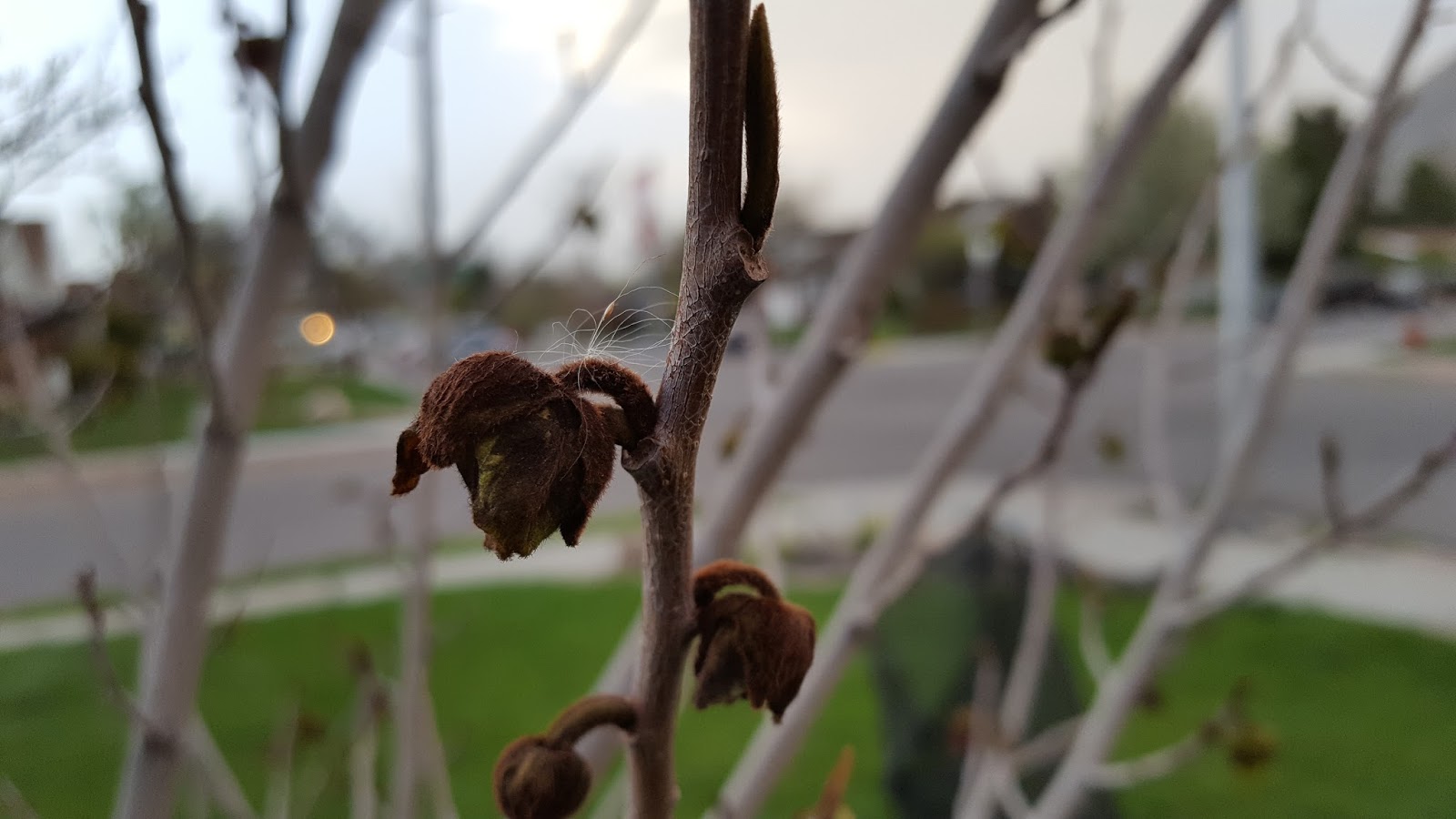
A closer look at a cold-weather casualty, poignantly crowned with a fibrous and wind-carried seed that (unlike this particular flower) may yet live.

Here's one that's still green, not yet the purple color that pawpaw lovers look for in the spring.

Here's one that's attained that classic purple look.

Twins.

Growing into the sky.

An early blossom that's in full bloom; note the white pollen grains on the petals. 

Not all blossoms are so lucky--here's one of the dead hangers-on, frozen and thawed and now brown.

And just as a reminder that these pawpaws aren't growing in the home range, here's a prickly pear from our weekend trip to the desert of southern Utah. I liked the shadow hanging under the cactus. If you click on the image you'll be able to see the shadows of individual cactus needles.

Monday, March 20, 2017

Western Scrub Jays in a Pawpaw Tree


Image result for bluejay
In its native land, the pawpaw is accustomed, I'm sure, to visits from the bluejay.


Image result for western scrub jay
But out expatriate pawpaws in Utah receive visits from the bluejay's cousin, the western scrub jay.


And I saw a pair of western scrub jays out on the Wells pawpaw this morning as I was heading off to work.

The one on the ground was picking through the mulch finding something to eat; it was the first one to fly away, followed by the one in the tree.

The pawpaw gave no indication either way whether it felt strange to be visited by western scrub jays rather than blue jays.

Sunday, March 19, 2017

What I Did During Winter Vacation from the Pawpaws

Over the winter...

...there wasn't as much going on with the pawpaws, besides being covered in snow.


To be sure, I knew how they felt at times, but at other times I was thinking about other things, like...

...plant five bonsai citrus trees and keeping them on my office window sill. From ebay, I ordered a Meyer lemon, a Persian lime, a Moro blood orange, another Meyer lemon because the first one died, and a Flame grapefruit.
I also went down to the San Rafael Swell and walked among the red rock cliffs and frozen puddles...


...and petroglyphs and...

...overcast skies.


And we snow-shoed.


And then spring and the wood ducks showed up, and the pawpaws began coming back to life.

Planting Pawpaw Seeds and Hoping to Get Some Plum Cuttings to Root

Spring has really arrived here in Utah, and the pawpaws know it. 

All of the bigger pawpaws in our yard have buds that are getting ready to burst forth in deep purple blossoms.

And the seedlings that grew from the twenty seeds that I planted in March 2016 are also attuned to the warm weather, with a few of them showing some green on their apex leaf buds. (This pic looks so patriotic, the way it has red and white stripes in the background. I think that's red duct tape and whitish plastic in the background--not, as I'm sure most of you are thinking, the "Merah-Putih," the Indonesian flag.)

The other evening I was texting with Dan and he sent me some picks of the work he's doing on getting cuttings from tree branches to root. To most people familiar with plants, I guess this is fairly common knowledge--you can take a cutting, put some rooting hormone on one end, and stick that end into the dirt. Or, you can place the cuttings in a plastic container with some water, and then let them sit in there for a few weeks. Getting cuttings to root is a way to make a tree that will be genetically identical to the tree from which the cutting is taken, so it produces the exact same fruit as the original tree. I hadn't known there was any way to do that except by grafting, which I don't yet know how to do. In any case, once I realized that Dan having success with apples and apricots, I remember the most delicious plum I've ever eaten. I ate it eight years ago, from the tree in the front yard of the parents of a friend of ours. So I contacted the friend to get his parents' phone number and address, and they were willing for me to take some cuttings from their plum tree. I had imagined maybe it was an underappreciated tree and that people didn't realize what good fruit it was. Not so, say his parents. They have people coming from all over the neighborhood to get their plums. And at one point, one of their neighbors (now moved) seems to have set up a ladder beneath the tree and kept it there, so he could get to their plums at his will and pleasure! Based on what I remember of the taste of the plum from eight years ago, I can understand why he would do that. The tree's owners were very generous. And perhaps their generosity was compounded by the profound ecological ethic promulgated by the Ernest Goes to Camp (1987), which only work of expressive culture that surpasses Aldo Leopold's A Sand County Almanac (1949) in terms of impact on American environmental thought. In that august 1987 film ("movie" too degrading a name for such a work of art), a character posits the questions: "Who can own a tree? Who can own a rock?"

 See the bramble of cuttings I took, above. Of course, as Ernest Goes to Camp reminds me: if the cuttings take root, I'll never truly own them.

I stuck the cuttings in a picture of water over night and this morning I planted some using the root hormone and soil method.

And I used the plastic container approach with some other sticks from the plum cuttings. Incidentally, I've read that in terms of pawpaw cultivation, it's the holy grail to be able to propagate pawpaws from cuttings, rather than from grafting. And by holy grail, I mean no one has yet found the method to do so. (The article says people have been successful propagating from cuttings from very young pawpaw seedlings, but of course that's useless, since the seedlings wouldn't fruit before the cutting-propagation window is closed, and the whole reason to propagate a cutting is to duplicate the fruit.) 

After I got things set up for my attempt at growing a delectable plum tree from cuttings, I turned my attention to planting some pawpaw seeds. Like last year, I used Arrowhead water bottles as my containers. And whereas I planted twenty seeds last year, I planted forty-eight seeds this year. But this year I didn't bother with labeling anything and making letter-number coordinates like "B6" and "C2". There were too many seeds in the fall to keep track of any of that, so I just got the seeds and put them in the dirt. You may remember that I stratified the seeds in several layers of paper towels. I only had containers enough to plant the seeds from not even one layer.

So after planting seeds in the containers, I decided to try an experiment--I went into our "backyard" (we hardly have a backyard, that's why all our pawpaw trees are in our front yard) and threw maybe a hundred or two hundred seeds in among the English ivy that forms the riotous border between our property and our neighbors' property. I know the ivy will give the pawpaw seeds some serious competition in terms of the seeds' attempt to root into the soil. But the ivy will also offer some good shade (combined with the red cedar trees) that may protect any seedling that happens to grow. I'd be happy to have some of them sprout and fortify the border between the two properties. I'd say a border pawpaw patch beats a border wall any day.

I also threw some seeds among these bushes here, on another border between our acreage (our .2 acre acreage) and a neighbor's property.

I'm not sure, though, what I'll do with the remaining seeds. We've still got more than half of them left.